
Guided audio practices
Box Breathing: Helpful in times of panic or overwhelm
4-7-8 Breathing: Helpful for relaxation, sleep and calming
Dropping Anchor: Helpful when distracted or overwhelmed and you need to focus
Grounding in the body: Helpful if feeling dissociated and as a regular practice to regulate nervous system
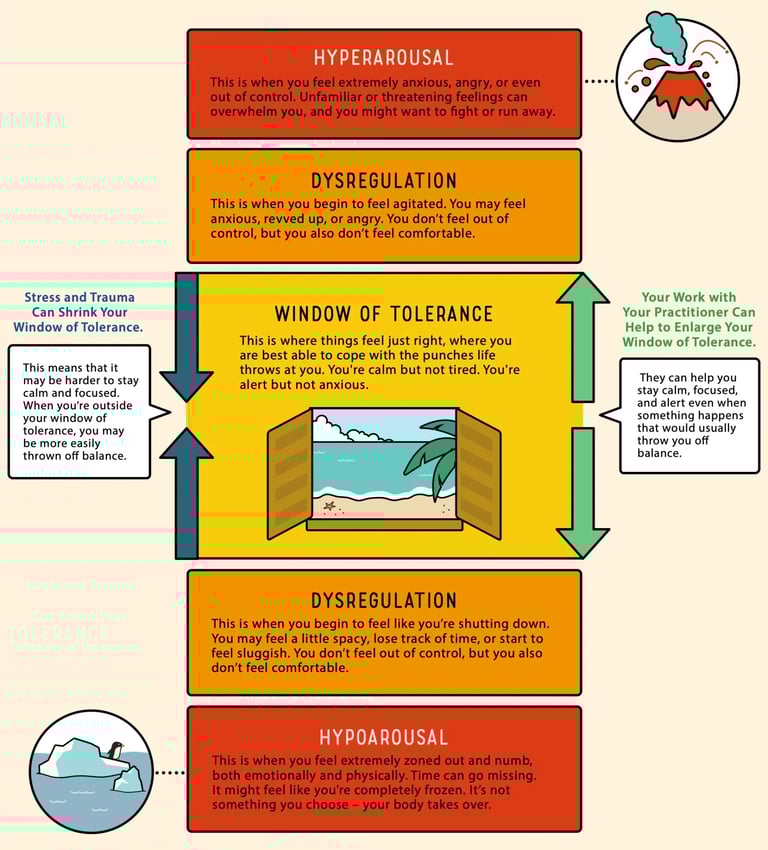
Understanding our window of tolerance
Copyright 2019 The National Institute for the Clinical Application of Behavioral Medicine
The window of tolerance is a concept originally developed by Dr. Dan Siegel, MD to describe the optimal zone of “arousal” for a person to function in everyday life. When a person is operating within this zone or window, they can effectively manage and cope with their emotions and stressors.
However, experiencing trauma, burnout and moral injury can narrow our window of tolerance and push us into dysregulation that can escalate to us feeling either hyper or hypoaroused.
Signs of hyperarousal
Signs of hypoarousal
Navigating dysregulation
Navigating hyperarousal
There are two levels in which we can work with our 'window of tolerance.' One is engaging in daily practices and lifestyle habits that can gradually expand our window of tolerance over time. Think anything that makes you feel more grounded and resilient.
This generally includes diet, sleep, exercise, community/socializing, consumption of alcohol/stimulants/caffeine/other substances, relationship to social media/media/tech, work balance, medication (if desired & prescribed), meditation/prayer/contemplation, creative hobbies and connection to your core values. You can talk to your individual counselor more about finding what works best for you.
The other level is creating a toolbox of practices and resources for returning to our window of tolerance if we have become hyper or hypo aroused. You'll notice that there are quite a few things that can help with both as they're two sides of the same coin.
Hyperarousal can manifest in a variety of ways and the intention is to find ways to calm and ground yourself without forcing it too quickly or intensely as this can paradoxically cause more anxiety. Healthy lifestyle changes can make a huge impact on the intensity and frequency of our hyperarousal.
Paced Breathing: Deep breaths, especially through the mouth, can make things worse. Instead, focus on slow, diaphragmatic breathing through your nostrils where your exhales are longer than your inhales.
5-4-3-2-1 Technique: Identify 5 things you see, 4 you can touch, 3 you hear, 2 you smell, and 1 you taste.
Cold Therapy: Hold ice cubes, place a cold cloth on the face, take a cold shower or bite into a frozen lemon to disrupt the fight-or-flight response.
Sensory Input: Use weighted blankets, listen to calming music, or use essential oils like lavender.
Body Scan: Intentionally focus on relaxing tense muscles, starting from the toes up to the head (don't do this if you're feeling panicky, this is best if you're only mildly dysregulated).
Proprioceptive Input: Push against a wall or engage in strength or resistance training to feel grounded internal sensory input.
Movement: Shake out limbs, do gentle stretching, or go for a slow walk to process excess adrenaline.
Match the Energy: sometimes when we're feeling "wired," it can be more helpful
Oral Sensory: Sip water through a straw to encourage slow, rhythmic breathing.
Singing or Humming: Singing a favorite song or even humming can help process excess energy and create a sense of grounding.
Name the State: Acknowledge that you are in a "fight" or "flight" state that is temporary and will pass.
Navigating hypoarousal
Hypoarousal often feels like a sense of being frozen, numb or dissociated so the goal here is to gently bring more awareness and energy to your mind and body. Again, you don't want to force it and it's helpful to go gradually.
Move to Wake Up: Stand up, walk around, or do light stretches to break the "freeze" response.
Sensory Input: Engage your senses to combat numbness. Use strong sensations like holding an ice cube, splashing freezing water on your face, or using essential oils.
"Shake Off" the Freeze: Gently jump or shake your arms and legs to release built-up, stagnant energy.
Adjust Posture: If slumping, consciously straighten your spine and open your chest.
Push Against Wall & Floor: Place your hands on a wall and push firmly to ground your energy and feel your body's strength. You can do the same thing with your feet on the ground (this is great for when you're in a meeting or somewhere you can't move from).
Name the State: Acknowledge that you are in a "shutdown" or "frozen" state to reduce panic and reinforce that it is normal and will pass.
Connect with Others: Social engagement helps regulate the nervous system.
5-4-3-2-1 Technique: Identify 5 things you see, 4 you can touch, 3 you hear, 2 you smell, and 1 you taste.
Eat Crunchy Foods: The sensation of biting and chewing can bring you back into the present.
Listen to Music: Play fast-paced, upbeat, or activating music to boost energy.
Tactile Stimulation: Use a fidget toy, squeeze a stress ball, or wrap yourself in a warm blanket.
Navigating grief
Grief is often defined as love that has nowhere else to go. There are two very broad categories of loss: unambiguous and ambiguous. Unambiguous loss is often the death of someone, particularly after a long life. The grief and loss are still painful, of course, but there isn't much ambiguity in it. Ambiguous loss, on the other hand, is every other type of loss where there is a sense of uncertainty, doubt, confusion or injustice. Ambiguous loss can include everything to the end of a relationship to feeling exiled from your homeland to the collective grief of ongoing occupation.
While grief is a natural and healthy response to any type of loss, it can often leave us feeling stuck, alone and unable to process our emotions. Grieving practices and rituals are individually and culturally dependent and diverse but there are a few 'frameworks' of grief that might be helpful in conceptualizing your experience of loss and what types of response feels most resonant for you. You can talk more with your individual counselors about what types of practices might be most helpful for you.
Five Stages of Grief
Continuing Bonds
The five stages of grief is both the most well-known and most misunderstood model of grief that posits that humans pass through five stages of grief: denial, anger, bargaining, depression, and acceptance. It was originally developed as a model of how people facing their own terminal illness process grief for their own lives but has since been taken out of that context and applied mostly to people experiencing the death of others or other types of grief.
While this framework is not supported by any empirical evidence and does not consider diverse cultural responses to grief, some of the stages might offer language for expressing your own experiences of grief. However, it's important to emphasize that even if we experience these stages, they are rarely linear and nothing is 'wrong' with you if you experience them in a different order or not at all.
The Dual Process model of grief is a more evidence-based framework that includes space for individually and culturally diverse experiences of grief. It posits that while every experience of grief is unique, most people respond to loss by alternating back and forth between Loss-Oriented Coping & Restoration-Oriented Coping.
Far from linear or neat stages, we switch back and forth between these two types of coping. Loss-Oriented Coping involves directly confronting and processing the pain and emotional impact of the loss. This can include feeling and expressing sadness, anger, or longing; reminiscing, looking at old photos, and sharing memories; engaging in grief rituals; yearning for the person or whatever was lost and feeling the full weight of loss
Restoration-Oriented Coping focuses on adapting to a new life and functioning in a world after loss. It involves dealing with the "secondary stressors" that come with the loss and can include taking on new roles and responsibilities; establishing new routines and interests; seeking distraction from the pain; focusing on day-to-day tasks and future goals to build a sense of normality.
This model normalizes the nonlinear process of grief and validates the dual experience that so many people feel after a loss. It can also help soothe guilt we might feel for 'moving on' or going about daily activities in the face of loss.
The Continuing Bonds model of grief challenge traditional models of grief that focus on detachment and 'letting go.' Instead, it focuses on supporting people in maintaining an ongoing and transformed relationship with the person or thing that was lost.
This framework can help normalize common responses to loss and support people in finding adaptive ways to transform their relationship to the person, place, thing or experience that was lost. Continuing relationships can include rituals, remembering, sharing about the loss and integrating it into your new roles and daily life.
While traditionally applied to people who have lost a person to death, this model can also be supportive in navigating more ambiguous losses like feeling exiled from your homeland, separated from family and grieving a hoped for future. Rather than forcing yourself to 'let go' or 'move on,' this framework can support you in finding ways to keep your connection to loss alive and use it to live as meaningful of a life as possible moving forward.